


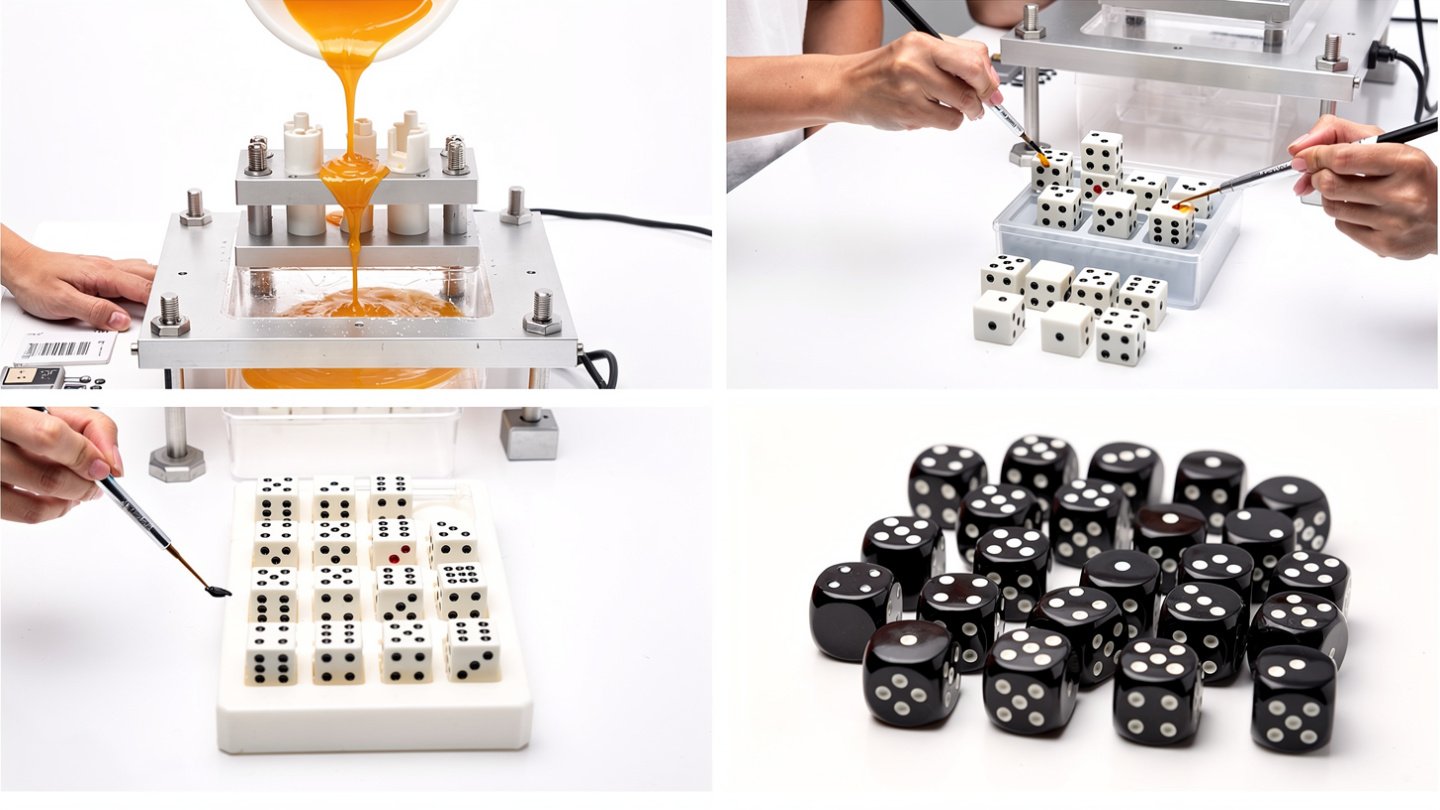
Ambil dadu apapun dan Anda memegang keajaiban kecil pembuatan presisi. Kubus kecil ini memberikan acak yang adil melalui desain hati-hati, bahan berkualitas, dan mengejutkan proses produksi kompleks. Apakah terbuat dari plastik, kayu, logam, atau batu permata, setiap dadu mengikuti perjalanan dari bahan baku ke alat game selesai.
Memahami bagaimana dadu dibuat mengungkapkan kerajinan di belakang objek kita sering mengambil untuk diberikan. Proses menggabungkan teknik tradisional dengan teknologi modern untuk menciptakan produk yang konsisten, seimbang, dan indah yang melayani pendidikan, hiburan, dan tujuan artistik.
Panduan komprehensif ini berjalan melalui proses pembuatan dadu lengkap. Kami akan menjelajahi bahan, metode produksi, kualitas kontrol, teknik khusus, dan perbedaan antara dadu diproduksi dan buatan tangan. Pada akhirnya, kau akan menghargai keterampilan dan perhatian yang diperlukan untuk menciptakan teman bermain penting ini.
Materials Digunakan dalam Dice Manufaktur
Dice produksi dimulai dengan memilih bahan yang sesuai. Zat yang berbeda memberikan manfaat yang berbeda untuk penampilan, daya tahan, berat, dan biaya.
Materials Plastik dan Acrylic
Kebanyakan dadu modern berasal dari senyawa plastik, terutama selulosa asetat atau resin akrilik. Bahan-bahan ini mendominasi pasar karena mereka menggabungkan kemampuan, daya tahan, dan produksi mudah.
Selulosa asetat berasal sebagai salah satu plastik komersial pertama pada awal abad ke-20. Pembuat menghargai motivasi dan stabilitas. Material menerima pewarna menyala dengan baik, menghasilkan dadu dalam setiap warna dibayangkan. Mesin ini secara bersih untuk tepi dan permukaan yang tepat.
Resin ajaib menawarkan manfaat yang sama dengan peningkatan kejelasan dadu transparan. Material ini menyembuhkan keras dan scrach- tahan. Mereka mempertahankan stabilitas dimensi melintasi perubahan suhu, yang mencegah warping yang dapat mempengaruhi keseimbangan.
Formula thermoplastic modern memungkinkan produsen untuk menciptakan dadu dengan efek khusus seperti pusaran, suspensi glitter, pergeseran warna, dan benda tertanam. Ini variasi artistik membuat masing-masing dadu visual unik sementara menjaga keadilan fungsional.
Kayu untuk Aestetika Alam
Dadu kayu menarik bagi pemain yang lebih suka bahan organik dan tekstur alami. Craftspeopel biasanya menggunakan kayu keras seperti maple, cherry, kenari, oak, atau spesies eksotis untuk kepadatan dan ketahanan mereka.
Kayu membutuhkan pendekatan produksi yang berbeda dari plastik. Pola gandum membuat setiap dadu benar-benar salah satu dari jenis. Material terasa hangat untuk menyentuh dan mengembangkan karakter melalui penggunaan. Namun, kayu lebih rentan terhadap kerusakan kelembaban dan membutuhkan penanganan lembut daripada plastik.
Manufaktur memperlakukan dadu kayu dengan finish yang melindungi terhadap kelembaban sementara menyoroti biji-bijian alami. Dadu kayu berkualitas berasal dari bahan-bahan sumber yang bertanggung jawab, menarik bagi konsumen sadar lingkungan.
Logam untuk Premium Weight
Logam dadu memberikan heft substansial dan memuaskan suara bergulir. Bahan umum termasuk campuran seng, aluminium, tembaga, kuningan, dan baja. Beberapa versi mewah menggunakan logam berharga, meskipun ini melayani terutama sebagai koleksi.
Proses pembuatan untuk dadu logam berbeda secara signifikan dari produksi plastik. Logam membutuhkan casting, mesin, atau keduanya. Hasil akhir produk merasa padat dan substansial di tangan. Berat badan mereka mempengaruhi perilaku bergulir, biasanya memproduksi gulungan pendek dengan pendaratan yang lebih otoriter.
Logam dadu perlu perlindungan selesai untuk mencegah tarnishing dan oksidasi. Manufaktur menerapkan pelapisan, anodisasi, lapisan bubuk, atau pengobatan lain yang menambahkan warna ketika melindungi logam dasar. Proses ini berkontribusi secara signifikan terhadap penampilan terakhir dan ketahanan.
Batu dan permata untuk kecantikan
Batu dadu mewakili akhir premium pasar. Semi- batu berharga seperti obsidian, giok, ametis, mata harimau, dan hematite menjadi dadu menakjubkan melalui pekerjaan layodi terampil.
Setiap dadu batu membutuhkan tenaga kerja tangan yang signifikan. Artisan memotong batu kasar menjadi bentuk kubus, menggiling semua wajah datar dan persegi, cat permukaan untuk smoothness, dan menggali lubang pipa hati-hati untuk menghindari retak. Variasi alami dalam batu berarti tidak ada dua dadu pernah terlihat identik.
Dadu batu terutama untuk kolektor dan gift-givers. Kerapuhan mereka membuat mereka tidak cocok untuk gameplay kuat, tapi kecantikan mereka mengubahnya menjadi potongan percakapan dan tampilan item.
Proses Manufaktur untuk Dice Plastik
Produksi dadu plastik massal mengikuti proses sistematis yang disempurnakan selama puluhan tahun untuk memaksimalkan kualitas dan efisiensi.
Step One Material Preparation
Produksi dimulai dengan plastik mentah di pellet atau bentuk bubuk. Manufaktur mencampur dasar resin dengan warna, stabilisator, dan setiap efek khusus tambahan. Pengcampuran ini harus menyeluruh untuk memastikan warna dan properti yang konsisten sepanjang batch.
Bahan campuran feed ke hoppers yang memasok mesin cetakan. Kontrol suhu yang tepat membuat plastik tetap konsisten optimal untuk mengalir ke cetakan tanpa merusak material.
Langkah Dua Penginapan Molding
Kebanyakan dadu plastik berasal dari injeksi cetakan, proses yang membentuk plastik cair di bawah tekanan tinggi. Manufaktur menciptakan cetakan baja presisi yang membentuk ruang negatif dari beberapa dadu secara bersamaan.
Mesin memanaskan plastik sampai mengalir seperti madu tebal, kemudian menyuntik ke rongga jamur tertutup di bawah tekanan yang luar biasa. Tekanan ini memaksa bahan ke setiap sudut dan memastikan mengisi penuh cetakan.
Plastik mendinginkan dan mengeras dalam beberapa detik. Cetakan terbuka secara otomatis dan pin ejektor mendorong dadu terbentuk keluar ke baki koleksi. Mesin modern menyelesaikan siklus ini setiap beberapa detik, menghasilkan ribuan dadu per hari.
Suntikan membentuk dadu dengan dimensi yang konsisten dan permukaan halus. Proses ini bekerja dengan indah untuk warna padat dan membutuhkan pekerjaan minimal selesai melampaui menghapus titik-titik kecil di mana plastik memasuki cetakan.
Langkah Tiga Membuat Pips dan Nomor
Setelah bentuk kubus dasar, produsen menambahkan angka. dadu tradisional menggunakan pips, titik-titik kecil itu mewakili nilai dari satu sampai enam. variasi modern kadang-kadang menggunakan terukir atau nomor dicetak sebagai gantinya.
Untuk dadu pipa klasik, produsen menggunakan peralatan pengeboran presisi. Komputer-dikendalikan bit bor membuat lubang seragam di posisi yang tepat untuk setiap nomor. Kedalaman harus konsisten di semua wajah untuk menjaga keseimbangan berat badan.
Setelah pengeboran, pekerja mengisi lubang pipa dengan cat kontras. Cat ini harus sesuai dengan kepadatan bahan yang dibuang untuk mencegah menciptakan ketidakseimbangan berat badan. Pabrik berkualitas tinggi merumuskan lukisan khusus khusus untuk tujuan ini.
Beberapa produsen menggunakan metode alternatif seperti ukiran laser atau pencetakan pad untuk menambah angka. Teknik ini menghindari penghapusan bahan dan berpotensi mempengaruhi keseimbangan. Mereka bekerja sangat baik untuk dadu kustom dengan logo, teks, atau grafis kompleks.
Langkah Empat Tumbling dan Memban
Raw molded dice have sharp edges and sometimes little imperfections from the molding process. Tumbling smooths ini tepi dan menciptakan sedikit bulat sudut akrab pada kebanyakan dadu game.
Manufaktur memuat batch dadu ke drum berputar sebagian diisi dengan media polishing. Sebagai drum berputar, dadu jatuh terhadap satu sama lain dan media, secara bertahap memakai tepi tajam turun dan halus permukaan.
Durasi gemuruh mempengaruhi ketajaman ujung akhir. Tumbuhan yang lebih lama menghasilkan pinggiran tanah, sementara periode yang lebih pendek mempertahankan sudut yang lebih tajam. Beberapa komunitas game lebih suka tepi tajam untuk perilaku bergulir yang lebih dapat diprediksi, sementara yang lain mendukung pinggiran untuk penanganan lembut dan gulungan lebih tenang.
Setelah jatuh, dadu pergi melalui pembersihan untuk menghapus sisa polishing. Mereka muncul siap untuk inspeksi kualitas dan kemasan.
Kontrol Lima Kualitas Langkah dan Pengujian
Reputable manufacturers inspect dice before they reach customers. Quality control checks multiple factors that affect both appearance and functionality.
Visual inspection identifies cosmetic defects like air bubbles, color inconsistencies, incomplete pip filling, or surface scratches. Dice with visible flaws get rejected from premium product lines, though some may be sold as economy versions.
Dimensional measurement verifies that each face measures correctly and all angles are true right angles. Even small deviations can affect rolling fairness, so precision manufacturers use calibrated gauges to check sample dice from each batch.
Balance testing involves rolling sample dice hundreds or thousands of times and recording results. Statistical analysis reveals whether numbers appear with expected frequency. Batches that show bias get rejected or reformulated.
Some manufacturers also test durability by subjecting dice to repeated drops, temperature cycles, and handling simulation. These tests ensure the product withstands normal use without degrading.
Handcrafted Dice Production Methods
While factories produce most dice, artisan crafters create custom pieces using traditional techniques that emphasize individuality over mass production.
Casting Resin Dice
Small-scale makers often use resin casting to create artistic dice with unique visual effects. The process starts with silicone molds made from master dice or precision-cut forms.
The crafter mixes liquid resin with hardener, adds colorants or special effects like glitter or dried flowers, and pours the mixture into the mold cavities. The resin cures over several hours, hardening into solid dice.
After demolding, the crafter sands all faces perfectly flat and square using progressively finer grits. This hand finishing requires patience and skill to achieve proper geometry. The edges receive careful attention to ensure uniformity.
Finally, the maker drills pip holes by hand or with small precision tools, fills them with contrasting material, and applies protective coatings. Each dice takes significant time compared to factory production, but the results showcase individual artistry.
Machining Metal and Wood Dice
Crafters who work with metal or wood often use precision machining equipment. Small CNC mills can cut perfect cubes from solid stock material with computer-guided accuracy.
The process begins with raw material in bar or block form. The machine cuts the basic cube shape, then drills pip holes or engraves numbers according to programmed coordinates. Multiple operations may be needed to access all six faces.
After machining, the crafter hand-finishes surfaces through sanding, polishing, or other techniques appropriate to the material. Metal dice receive protective coatings or platings. Wood dice get oils, waxes, or clear finishes that protect while enhancing natural beauty.
Stone Cutting and Polishing
Creating dice from natural stone requires traditional lapidary skills. The process starts with rough stone that the artisan cuts into approximate cube shapes using diamond saws.
Each face must be ground perfectly flat using progressively finer grinding wheels. The craftsperson checks squareness constantly with precision measuring tools. Achieving six truly flat faces at perfect right angles requires considerable skill and patience.
After shaping, the stone goes through polishing stages using various compounds and buffs. The goal is mirror-smooth surfaces that showcase the stone’s natural colors and patterns.
Drilling pip holes in stone risks cracking or chipping. Artisans use specialized diamond drill bits, gentle pressure, and sometimes water cooling to create clean holes without damaging the surrounding material. Some stone dice use inlaid metal or contrasting stone for pips instead of drilled and painted holes.
Specialty Manufacturing Techniques
Beyond standard production, manufacturers use special techniques to create dice with unique properties.
Precision Casino-Grade Dice
Professional gaming dice undergo extreme quality control. Manufacturers machine these dice to tolerances measured in thousandths of an inch. Every dimension receives verification, and balance gets tested extensively.
These dice feature sharp edges rather than tumbled corners. The crisp edges produce more consistent rolling behavior according to physics research from institutions like MIT. They often use transparent materials so any internal flaws would be visible.
The pips get special attention. Some precision dice use flush-mounted pips where paint sits perfectly level with the surface rather than filling drilled holes. This technique eliminates even microscopic weight differences.
Transparent and Layered Effect Dice
Creating clear dice with suspended effects requires careful resin formulation. Manufacturers must achieve perfect clarity while incorporating glitter, color swirls, or embedded objects without creating air bubbles.
Some artisan dice feature multiple colored layers visible through transparent outer layers. Creating these requires pouring and partially curing resin in stages, building up the visual effect layer by layer.
The technical challenge involves managing cure times, temperatures, and pour techniques so layers bond perfectly without visible seams or trapped air. Successful results create stunning three-dimensional visual effects.
Custom Logo and Artwork Dice
Businesses, schools, and game publishers often order custom dice featuring logos, mascots, or special artwork. Manufacturers use various techniques to apply these custom elements.
Pad printing transfers ink designs onto dice surfaces using silicone pads. The process handles complex multi-color artwork accurately. UV printing uses specialized printers that cure ink instantly with ultraviolet light, enabling detailed full-color images.
Laser engraving removes surface material to create permanent marks that never wear off. This technique works beautifully on wood, metal, and certain plastics. The contrast between engraved areas and original surface creates visible numbers or designs.
Environmental Considerations in Dice Manufacturing
Modern manufacturers increasingly address environmental impacts of their production processes.
Plastic waste reduction happens through recycling rejected dice back into production. Failed batches get reground into pellets and remixed rather than discarded. This closed-loop approach minimizes material waste.
Some companies now offer dice made from biodegradable plastics derived from plant sources rather than petroleum. These materials perform similarly to traditional plastics but break down more readily after disposal.
Wood dice manufacturers increasingly source from certified sustainable forests where harvesting follows strict environmental and replanting standards. This approach ensures dice production does not contribute to deforestation.
Water-based paints and finishes replace solvent-based products in environmentally conscious facilities. These alternatives reduce air pollution and worker exposure to harmful chemicals while delivering similar performance.
Energy-efficient manufacturing equipment cuts the carbon footprint of dice production. Modern injection molding machines use less power while producing more consistent results than older models.
The Future of Dice Manufacturing
Innovation continues in this ancient product category. New technologies open possibilities that previous generations could not imagine.
3D printing enables completely customized dice production in small quantities. Customers design unique dice using software, then print them at home or through service providers. While current 3D printing struggles with the precision needed for perfectly balanced dice, improving technology may solve these limitations.
Smart dice with embedded electronics can communicate roll results to companion apps via Bluetooth. These hybrid physical-digital products blend traditional tactile rolling with modern connectivity. Manufacturing these requires integrating circuit boards and batteries into dice bodies, presenting interesting engineering challenges.
New materials continue emerging. Manufacturers experiment with ceramics, composites, and advanced polymers that offer unique properties. Each new material requires developing appropriate production techniques.
Automated quality control using computer vision and artificial intelligence can inspect dice more thoroughly and consistently than human workers. These systems photograph dice from all angles and use algorithms to detect even tiny defects.
Despite these advances, the fundamental goal remains unchanged: creating small cubes that roll fairly and serve their purpose in games, education, and entertainment.
Appreciating the Craft
Next time you pick up dice for a game or classroom activity, take a moment to appreciate the journey they made from raw material to finished product. Whether mass-produced in efficient factories or handcrafted by skilled artisans, each dice represents technical knowledge, quality materials, and attention to detail.
The simple cube in your hand connects ancient gaming traditions with modern manufacturing capability. It demonstrates how straightforward objects still require considerable expertise to create properly. And it reminds us that even small everyday items deserve appreciation for the craft behind them.
If you found this exploration of dice manufacturing interesting and informative, please share it with educators, game enthusiasts, makers, and curious learners. Have you ever tried making dice yourself? Do you have questions about specific manufacturing techniques? Share your thoughts and experiences in the comments below. We enjoy hearing from readers and continuing conversations about these fascinating little objects.
Catatan: Artikel ini hanya untuk informasi dan tujuan hiburan saja. Ini tidak mempromosikan atau mendorong perjudian uang.


