


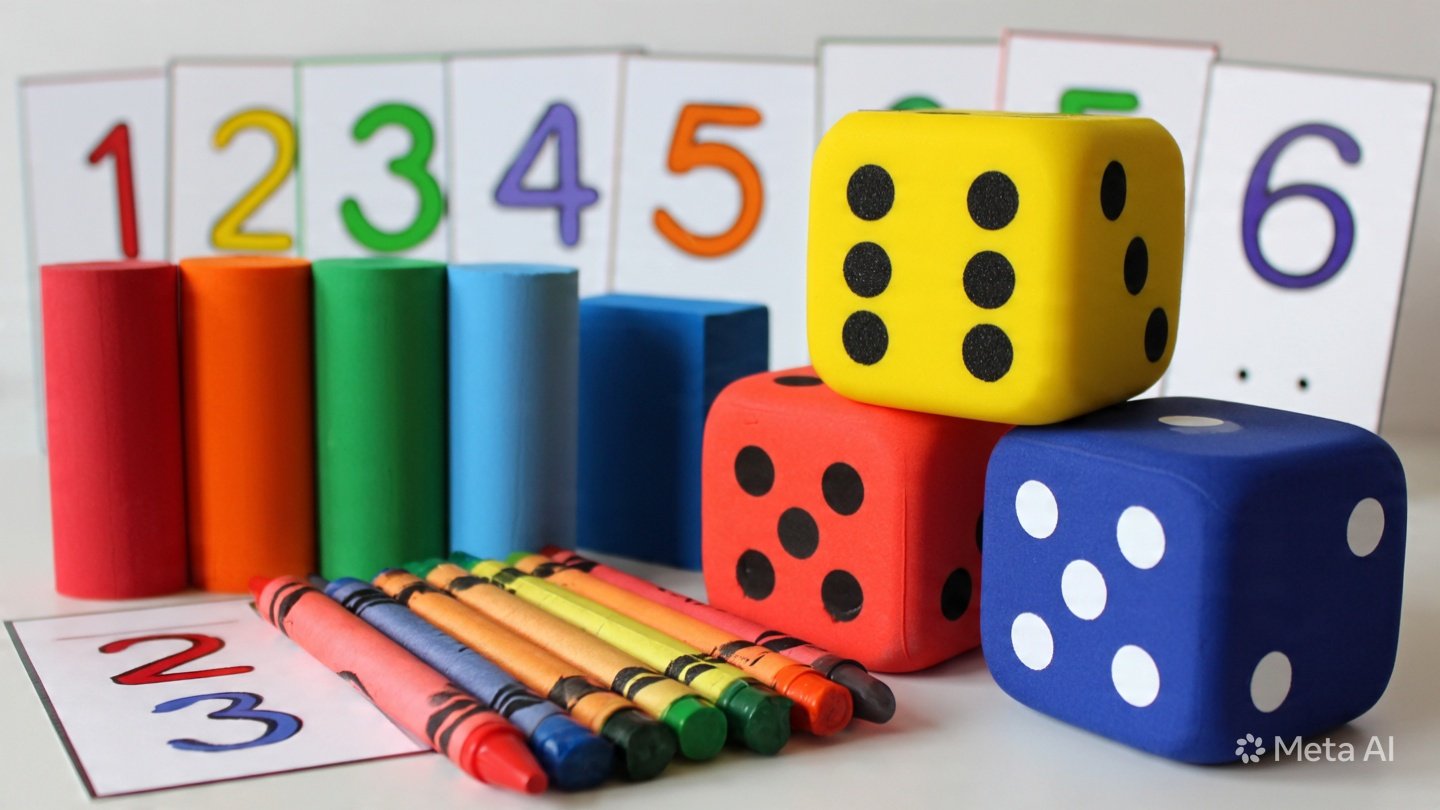
Dice games for preschool math are simple, playful, and easy to use at home or in the classroom. Preschool children learn best when they can touch, count, move, build, and play. Dice make math feel like a game instead of a lesson.
A single die can help children recognize numbers, count dots, match quantities, compare more and less, build towers, find colors, and practice early addition. These activities do not need expensive materials. Large dice, blocks, counters, crayons, paper, and a few simple rules are enough.
This guide shares easy dice games for preschool math. Each game is designed for young learners and includes simple instructions, learning goals, examples, and parent or teacher tips.
Why Dice Games Help Preschool Math
Preschool math should be visual, hands-on, and short. Dice are perfect because children can see dots, count them, and connect them with real objects.
| Preschool Math Skill | How Dice Games Help |
|---|---|
| Counting | Children count dots and objects |
| Number recognition | Children identify numbers from 1 to 6 |
| One-to-one matching | Children match dice numbers with objects |
| More and less | Children compare two rolls |
| Early addition | Children combine two small numbers |
| Fine motor skills | Children roll dice, stack blocks, and mark paper |
| Focus | Children follow short rules |
| Turn-taking | Children wait and play with others |
Dice games also build confidence because children can learn through repetition without feeling pressure.
Materials Needed
| Material | Use |
|---|---|
| Large foam die | Safe and easy for young children |
| Standard die | For older preschoolers with supervision |
| Blocks | Counting and building |
| Counters | Matching numbers |
| Crayons | Marking, coloring, and drawing |
| Paper | Simple score sheets and number mats |
| Cups or bowls | Sorting and collecting |
| Dice tray | Keeps dice from rolling away |
For preschoolers, large dice are better than small dice because they are easier to see and safer to handle.
Quick Preschool Math Dice Game Picker
| Game | Best Skill | Dice Needed | Time |
|---|---|---|---|
| Roll and Count | Counting | 1 | 5 min |
| Roll and Match | One-to-one matching | 1 | 5 min |
| Build a Tower | Counting and fine motor | 1 | 10 min |
| More or Less | Comparing numbers | 2 | 5–10 min |
| Number Hunt | Number recognition | 1 | 5 min |
| Color Count Dice | Counting and colors | 1 | 5–10 min |
| Roll and Clap | Counting with movement | 1 | 5 min |
| Dot to Object Match | Visual counting | 1 | 5 min |
| Roll and Add Small Numbers | Early addition | 2 | 10 min |
| Fill the Number Mat | Number practice | 1 | 10 min |
1. Roll and Count
Roll and Count is the easiest preschool dice math game. It helps children count dots and say numbers aloud.
Best for: Ages 3 to 5
Players: 1 or more
Dice needed: 1 large die
Time: 5 minutes
Main skill: Counting and number recognition
How to play
- Give the child one large die.
- Ask them to roll it gently.
- Count the dots together.
- Say the number aloud.
- Repeat for several rounds.
Example
| Dice Roll | Child Says |
|---|---|
| 1 | One |
| 2 | Two |
| 3 | Three |
| 4 | Four |
| 5 | Five |
| 6 | Six |
Parent tip:
Ask the child to touch each dot while counting. This helps them count carefully instead of guessing.
2. Roll and Match Objects
This game helps children match a number with a real quantity.
Best for: Ages 3 to 5
Players: 1 or more
Dice needed: 1 die
Time: 5 minutes
Main skill: One-to-one matching
How to play
- Put small objects on the table, such as blocks, toy cars, buttons, or crayons.
- The child rolls one die.
- Count the dots.
- The child picks the same number of objects.
- Count the objects again.
Filled example
| Dice Roll | Objects Picked |
|---|---|
| 1 | 1 block |
| 2 | 2 blocks |
| 3 | 3 blocks |
| 4 | 4 blocks |
| 5 | 5 blocks |
| 6 | 6 blocks |
Learning point:
This helps children understand that the number 4 means four real things, not just a symbol or sound.
3. Build a Tower Dice Game
Build a Tower is a hands-on preschool math game using blocks.
Best for: Ages 3 to 6
Players: 1 to 4
Dice needed: 1 die
Time: 10 minutes
Main skill: Counting, fine motor control, and patience
How to play
- Put blocks in the middle.
- The child rolls one die.
- The number tells how many blocks to add.
- Continue for 5 rounds.
- Count the final tower blocks.
Filled example
| Round | Dice Roll | Blocks Added | Tower Total |
|---|---|---|---|
| 1 | 3 | 3 | 3 |
| 2 | 2 | 2 | 5 |
| 3 | 4 | 4 | 9 |
| 4 | 1 | 1 | 10 |
| 5 | 5 | 5 | 15 |
Teacher tip:
For group play, let children build one shared tower. This makes the game cooperative instead of competitive.
4. More or Less Dice Game
This game helps preschoolers compare numbers.
Best for: Ages 4 to 6
Players: 2 or more
Dice needed: 2 dice
Time: 5 to 10 minutes
Main skill: Comparing more and less
How to play
- Roll two dice.
- Count the dots on each die.
- Ask: “Which number is more?”
- Ask: “Which number is less?”
- If both dice show the same number, say “equal.”
Example
| Die 1 | Die 2 | Answer |
|---|---|---|
| 5 | 2 | 5 is more |
| 1 | 4 | 1 is less |
| 3 | 3 | Equal |
| 6 | 4 | 6 is more |
Easy version:
Use number cards or counters to show the difference visually.
5. Number Hunt Dice Game
Number Hunt helps children recognize numbers in their environment.
Best for: Ages 4 to 6
Players: 1 or more
Dice needed: 1 die
Time: 5 minutes
Main skill: Number recognition and observation
How to play
- Roll one die.
- Count the dots.
- Ask the child to find that number somewhere nearby.
- They can look on books, toys, clocks, cards, or number charts.
- Repeat with a new roll.
Example
If the child rolls 3, they might find the number 3 on a book page, toy, worksheet, calendar, or wall chart.
Parent tip:
Keep a number chart nearby if the child is still learning number symbols.
6. Roll and Clap
Roll and Clap is a movement-based preschool math game.
Best for: Ages 3 to 5
Players: 1 or more
Dice needed: 1 die
Time: 5 minutes
Main skill: Counting with movement
| Dice Roll | Action |
|---|---|
| 1 | Clap 1 time |
| 2 | Clap 2 times |
| 3 | Clap 3 times |
| 4 | Clap 4 times |
| 5 | Clap 5 times |
| 6 | Clap 6 times |
How to play
- Roll one die.
- Count the dots.
- Clap that many times.
- Count aloud while clapping.
Variation:
Change the action to jumps, taps, stomps, or stretches.
Safety tip:
Use gentle movements and clear the space before playing.
7. Color Count Dice Game
This game combines colors and counting.
Best for: Ages 3 to 6
Players: 1 or more
Dice needed: 1 die
Time: 5 to 10 minutes
Main skill: Counting and color sorting
How to play
- Put different colored objects on the table.
- Choose one color, such as red.
- Roll the die.
- The child picks that many red objects.
- Repeat with another color.
Filled example
| Color | Dice Roll | Child Collects |
|---|---|---|
| Red | 3 | 3 red blocks |
| Blue | 5 | 5 blue crayons |
| Yellow | 2 | 2 yellow buttons |
| Green | 4 | 4 green toys |
Learning point:
This activity supports both math and color recognition.
8. Dot to Object Match
Dot to Object Match helps children connect dice dots with counted objects.
Best for: Ages 3 to 5
Players: 1 or more
Dice needed: 1 die
Time: 5 minutes
Main skill: Visual counting
How to play
- Roll the die.
- Count the dots.
- Draw the same number of circles on paper.
- Place one object on each circle.
- Count again.
Example
| Dice Roll | Draw Circles | Place Objects |
|---|---|---|
| 2 | 2 circles | 2 counters |
| 4 | 4 circles | 4 counters |
| 6 | 6 circles | 6 counters |
Teacher tip:
This is good for children who need visual support with one-to-one counting.
9. Roll and Add Small Numbers
This is an early addition game for older preschoolers.
Best for: Ages 5 to 6
Players: 1 or more
Dice needed: 2 dice
Time: 10 minutes
Main skill: Early addition
How to play
- Roll two dice.
- Count the dots on the first die.
- Count the dots on the second die.
- Count all dots together.
- Say the total.
Filled example
| Die 1 | Die 2 | Total |
|---|---|---|
| 2 | 3 | 5 |
| 1 | 4 | 5 |
| 5 | 1 | 6 |
| 3 | 3 | 6 |
Easy version:
Use one die and counters first. Move to two dice when the child is ready.
10. Fill the Number Mat
This game uses a simple paper mat with numbers 1 to 6.
Best for: Ages 4 to 6
Players: 1 or more
Dice needed: 1 die
Time: 10 minutes
Main skill: Number recognition and matching
How to play
- Draw six boxes on paper.
- Write numbers 1 to 6 in the boxes.
- The child rolls the die.
- They place a counter on the matching number.
- Continue until every number has at least one counter.
Example number mat
| 1 | 2 | 3 |
|---|---|---|
| 4 | 5 | 6 |
Filled example
| Dice Roll | Action |
|---|---|
| 4 | Place counter on 4 |
| 2 | Place counter on 2 |
| 6 | Place counter on 6 |
| 1 | Place counter on 1 |
Variation:
The child colors the matching number instead of placing a counter.
Preschool Math Skills by Game
| Math Skill | Best Dice Game |
|---|---|
| Counting dots | Roll and Count |
| Matching quantity | Roll and Match Objects |
| Comparing numbers | More or Less |
| Early addition | Roll and Add Small Numbers |
| Number recognition | Number Hunt |
| Fine motor practice | Build a Tower |
| Color sorting | Color Count Dice |
| One-to-one counting | Dot to Object Match |
| Movement counting | Roll and Clap |
| Number matching | Fill the Number Mat |
How to Make Dice Math Easier
| Problem | Easy Fix |
|---|---|
| Child guesses numbers | Count dots together slowly |
| Child loses interest | Play only 3 rounds |
| Child cannot add yet | Use one die and objects |
| Dice rolls away | Use a tray or bowl |
| Numbers are confusing | Use a number chart |
| Child struggles with waiting | Play solo or cooperative games |
| Activity feels too hard | Use fewer objects |
How to Make Dice Math More Challenging
| Child Is Ready For More | Add This |
|---|---|
| Counts 1 to 6 easily | Use two dice |
| Matches objects well | Ask “how many altogether?” |
| Recognizes numbers | Use written number cards |
| Enjoys building | Add tower challenges |
| Likes movement | Add action patterns |
| Can compare numbers | Ask “how many more?” |
Tips for Parents and Teachers
- Keep instructions short.
- Demonstrate one turn first.
- Use large dice for safety.
- Count aloud with the child.
- Let children touch objects while counting.
- Praise effort, not only correct answers.
- Stop before the child gets tired.
- Repeat favorite games often.
- Use everyday objects like blocks, spoons, toy cars, or crayons.
- Make the activity playful, not like a test.
Common Mistakes to Avoid
| Mistake | Better Choice |
|---|---|
| Using small dice with toddlers | Use large foam dice |
| Playing too long | Keep games short |
| Correcting too harshly | Guide gently |
| Moving to addition too fast | Build counting first |
| Making rules complex | Use one simple rule |
| Focusing only on winning | Focus on learning and fun |
| Not using objects | Use hands-on materials |
FAQs About Dice Games for Preschool Math
Are dice games good for preschool math?
Yes. Dice games help preschoolers practice counting, number recognition, matching quantities, comparing numbers, and early addition in a playful way.
What is the easiest dice game for preschoolers?
Roll and Count is the easiest. The child rolls one die, counts the dots, and says the number aloud.
What dice should preschoolers use?
Large foam dice or oversized dice are best because they are easier to see and safer for young children.
Can preschoolers learn addition with dice?
Older preschoolers can begin early addition by rolling two dice and counting all dots together. Use objects or counters for support.
How long should preschool dice games last?
Most preschool dice games should last 5 to 10 minutes. Short activities work best for young children.
Can dice games be used in preschool classrooms?
Yes. Teachers can use dice games for math centers, small groups, counting practice, movement breaks, and number recognition activities.
Are dice games safe for preschoolers?
Dice games are safe when large dice are used and adults supervise. Small dice should be kept away from children who may put objects in their mouths.
Final Thoughts
Dice games for preschool math are simple, hands-on, and fun. They help young children count, match, compare, build, move, and recognize numbers through play.
Start with easy activities like Roll and Count, Roll and Match, and Roll and Clap. When children are ready, try More or Less, Fill the Number Mat, and Roll and Add Small Numbers.
The best preschool math activities are short, visual, and playful. With one large die and a few everyday objects, children can build early math confidence while having fun.
Note: This article is for educational and entertainment purposes only. It does not promote betting, cheating, casino play, loaded dice, or real-money gambling.


