


The Balut dice game is a fascinating scoring-based entertainment activity that combines dice rolling with strategic planning. This engaging game has entertained players for decades while offering surprising depth beneath its simple surface. Whether you’re discovering Balut for the first time or seeking to master advanced strategies, this comprehensive guide covers everything you need to know about rules, scoring, and why this game captivates players worldwide.
Dice games have entertained humanity across cultures and centuries because they offer accessible entertainment requiring minimal equipment. Balut stands out among traditional games because it merges chance-based dice outcomes with meaningful strategic choices. The game creates exciting moments where players must decide which scoring categories to pursue and when to take calculated risks. Let’s explore everything about this captivating classic.
What Is the Balut Dice Game
Balut is a turn-based dice game where players roll five dice to create scoring combinations across thirteen different categories. The objective involves accumulating the highest total score by strategically selecting which scoring categories to use for each turn. Players complete the game after thirteen rounds, with the highest cumulative score winning.
The game’s name comes from a traditional Filipino food, but the actual game’s origins trace to Yahtzee and similar dice games. Balut offers more strategic depth than some comparable games because players must carefully decide which scoring categories to claim during each turn.
Balut accommodates two to four players comfortably, though variations allow for more participants. A typical game lasts thirty to forty-five minutes depending on player experience and decision-making speed. The game requires five dice and paper for score tracking, making it accessible with minimal materials.
The History of Balut Game
Balut emerged as a modern dice game sometime in the late twentieth century as players sought variations on established dice games like Yahtzee. The game borrowed core mechanics from Yahtzee while introducing different scoring categories and strategic elements. Players appreciated Balut because it offered familiar gameplay with fresh strategic challenges.
The game gained popularity through informal play among friends and families who enjoyed dice games. While Balut never achieved the mainstream recognition of some competitors, dedicated players developed strong communities around the game. Internet gaming platforms introduced Balut to global audiences, expanding its player base significantly.
Throughout the years, Balut has remained relatively unchanged in its fundamental structure, though various house rule variations emerged. The game’s staying power among enthusiasts demonstrates how well-designed the core mechanics are. Many players who discover Balut become enthusiastic advocates, introducing the game to new players within their circles.
Essential Equipment for Playing Balut
Getting started with Balut requires gathering basic materials that most households can provide.
The Dice
You need five standard six-sided dice for Balut. These regular dice show numbers one through six on each face. Any dice work perfectly whether they’re plastic, wood, or metal. The only requirement is that each die displays numbers clearly when rolled.
Scoring Materials
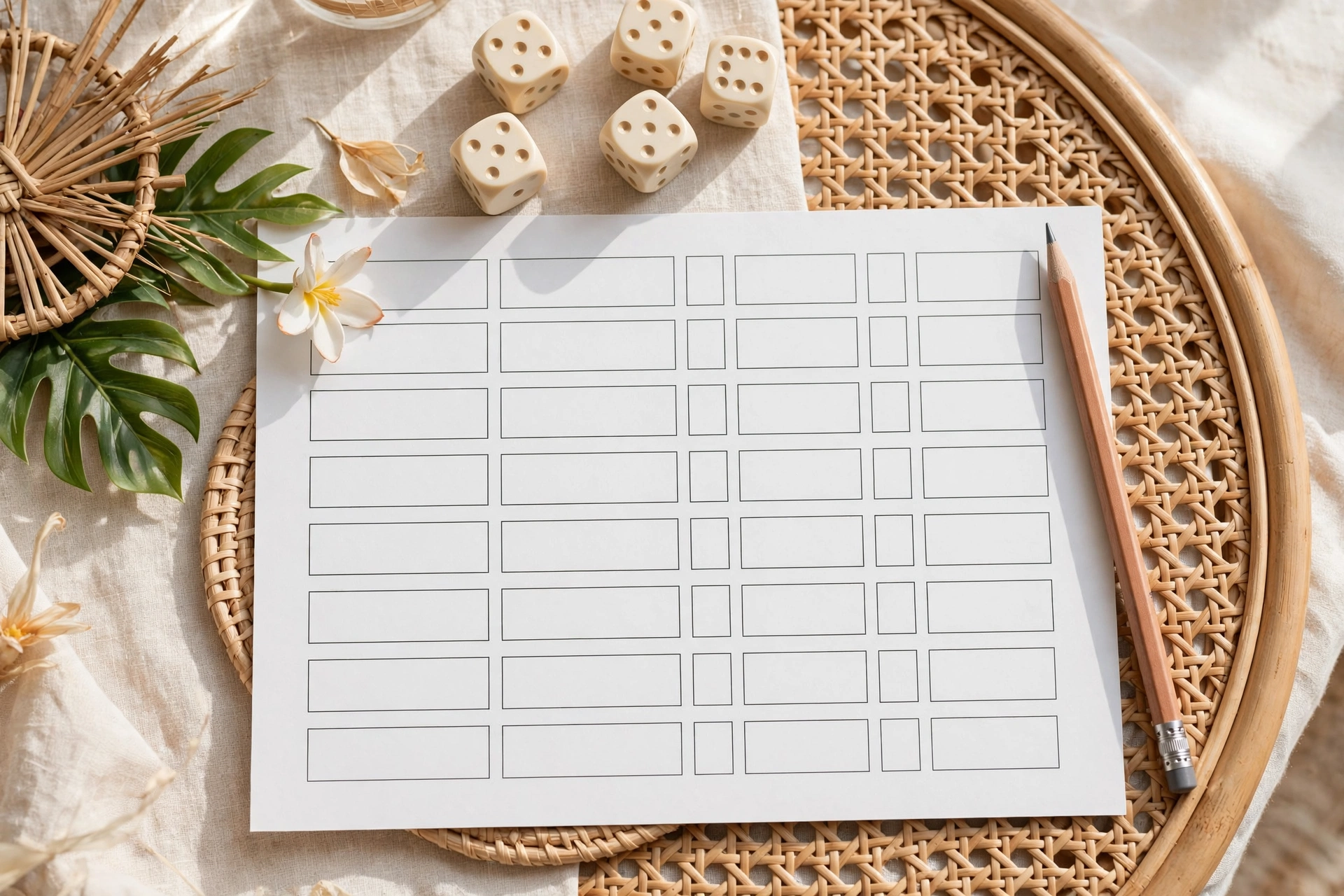
Keep paper and pencil handy for tracking scores throughout the game. You’ll create a score sheet with thirteen rows representing each category and columns for each player. Adequate writing space prevents errors and keeps scores organized. Some players use printed score sheets designed specifically for Balut.
Playing Surface
A flat table or hard surface works perfectly for rolling dice. Avoid soft surfaces like carpets or couches where dice roll unpredictably or disappear into crevices. A cup or dice shaker helps ensure fair rolls by preventing players from rolling dice too forcefully.
Understanding Scoring Categories
Balut features thirteen distinct scoring categories that form the foundation of the game’s strategy.
Upper Section Categories
The upper section includes six categories based on specific numbers appearing on dice.
Ones category scores the total of all ones rolled. If you roll three ones, you score three points in this category.
Twos category tallies all twos rolled. Four twos equal eight points in this category.
Threes category adds all threes together. Two threes provide six points.
Fours category counts all fours shown. One four equals four points.
Fives category totals all fives rolled. Three fives give fifteen points.
Sixes category sums all sixes showing. Five sixes yield thirty points.
These six categories can be claimed in any order and only once per game. Players strategically choose which category to claim based on their current dice roll.
Lower Section Categories
The lower section includes seven more complex categories requiring specific dice combinations.
Three of a Kind requires rolling at least three dice showing the same number. You score the total of all five dice. This differs from upper categories which only count specific numbers.
Four of a Kind requires four dice showing identical numbers. You score all five dice total.
Full House means three dice of one number and two dice of another number. This combination scores twenty-five points regardless of which numbers appear.
Small Straight requires four consecutive numbers like 1-2-3-4 or 3-4-5-6. This scores thirty points.
Large Straight requires all five dice showing consecutive numbers like 1-2-3-4-5 or 2-3-4-5-6. This scores forty points.
Balut represents five dice all showing the same number. This is the rarest combination and scores fifty points. Some versions call this “Yahtzee” in honor of the game it derives from.
Chance allows scoring any combination by simply totaling all five dice. This category catches rolls that don’t fit other categories.
Step-by-Step Gameplay Instructions
Following these detailed steps helps you understand exactly how Balut works.
Game Setup
Gather two to four players and seat them comfortably around a table. Create a score sheet listing all thirteen categories on the left side with columns for each player. Establish a player order using any fair method like drawing lots.
Place the five dice in the center of the table. Decide which player rolls first. Some groups rotate who goes first in subsequent games.
Taking Your Turn
When your turn arrives, pick up all five dice and shake them vigorously. Roll them onto the table so all players can see the results clearly. Don’t shield or hide the dice from view.
Look at the numbers showing on the dice. You’re now allowed up to two additional rolls to try improving your combination. The initial roll plus two rerolls gives you three total rolling opportunities.
First Reroll Decision
After your first roll, examine the result carefully. You can choose to keep all five dice, or set aside any dice you wish to keep and reroll the remaining dice. For example, if you rolled three fives, you might keep those three fives and reroll the other two dice hoping for more fives.
You’re not required to reroll. If you’re satisfied with your initial roll, you can skip both reroll opportunities and proceed directly to scoring. Some strategic situations warrant accepting your first roll rather than risking worse results.
Second Reroll Decision
If you used your first reroll, you now face another decision. You can keep your current dice combination or reroll unwanted dice one final time. Again, you choose which dice to keep and which to reroll.
After this second reroll, no more rolling is permitted. You must score your current dice combination in an available category.
Selecting Your Scoring Category
Once you’ve completed rolling, you must claim one unused scoring category for your current dice combination. You can’t use the same category twice, so strategic category selection becomes crucial.
For example, if you rolled three sixes after your rerolls, you could claim this in the Sixes upper category, or you could use it for Three of a Kind or Chance in the lower section. Your decision depends on your overall game strategy and what categories remain available.
Scoring Your Points
After selecting your category, calculate your points according to that category’s rules. Record your score on the sheet. Upper categories score only their matching numbers. Lower categories score according to their specific requirements.
Passing to Next Player
After recording your score, pass the dice to the next player. The game continues with each player taking a complete turn including rolling, rerolling decisions, and category selection.
Completing the Game
The game continues until all thirteen categories have been claimed by all players. After thirteen rounds, the player with the highest cumulative score wins.
Scoring Details and Examples
Understanding how different categories score helps with strategic planning.
Upper Section Scoring Example
If you roll 1-2-3-4-5 and choose the Fours category, you score four points. If you roll 4-4-4-4-6 and choose Fours, you score sixteen points because all four fours count.
Lower Section Scoring Example
If you roll 3-3-3-4-5 and choose Three of a Kind, you score eighteen points total from all five dice. If you roll 1-2-3-4-5 and choose Large Straight, you score forty points automatically.
Chance Category Example
If you roll 2-3-4-5-6 and all your other categories are claimed, you’d use the Chance category and score twenty points total.
Strategic Tips for Winning at Balut
While dice outcomes involve chance, strategic category selection significantly influences your score.
Plan Your Upper Section
Many experienced players aim to score at least sixty-three points in the upper section, which triggers a bonus in some versions. This requires strategic thinking about which upper categories to claim.
Preserve Valuable Categories
Don’t waste your Balut category on mediocre combinations. Save it for when you actually roll all five dice identically. Similarly, preserve Large Straight for when you genuinely roll consecutive numbers.
Understand Risk and Reward
Taking a second reroll risks making your combination worse. Sometimes accepting decent results beats chasing perfection.
Track Available Categories
Always know which categories remain unclaimed. This awareness guides your strategic decisions about which categories to claim for your current roll.
Balance Upper and Lower Sections
A winning strategy typically involves strategic distribution between upper and lower sections rather than neglecting either area.
Watch Opponent Progress
Notice which categories opponents have already claimed. This information helps you anticipate which categories they might target, influencing your own category selection.
Game Variations and House Rules
Many groups modify standard Balut to suit their preferences.
Bonus Point Systems
Some versions award bonus points for high upper section scores. These bonuses reward consistency in rolling matching numbers.
Alternative Category Rules
Certain groups modify what combinations qualify for each category or change point values. Establish house rules before beginning to prevent confusion.
Tournament Scoring
Some competitive groups use tournament formats where multiple games determine an overall winner rather than single-game outcomes.
Speed Play
Adding time limits to decision-making creates faster-paced games. Players might have thirty seconds to decide their reroll strategy and category selection.
Partnership Variations
Some groups play Balut in teams where partners take turns and combine scores. This adds collaborative strategy to the game.
Why Balut Captivates Players
This game has earned devoted players because it offers several genuine benefits.
Strategic Depth
Unlike purely chance-based games, Balut rewards thoughtful decision-making about category selection and reroll strategy. Every choice matters.
Balanced Luck and Skill
Pure luck games feel meaningless to many players. Pure skill games exclude players with less experience. Balut balances both elements nicely.
Multiple Viable Strategies
No single perfect strategy dominates Balut. Different approaches can succeed, making the game interesting across multiple plays.
Relatively Quick Gameplay
Games typically last thirty to forty-five minutes, keeping players engaged without excessive time commitment.
Engaging Decision Points
Players face meaningful choices every turn about which dice to keep and which category to claim. These decisions create genuine strategic engagement.
Minimal Equipment Needed
Five dice and paper are all you need. This accessibility makes Balut playable anywhere with minimal preparation.
Educational Benefits of Balut
Beyond entertainment, Balut offers several learning advantages for young players.
Mathematical Development
Players practice addition repeatedly while calculating scores. This reinforces math skills in a practical, engaging context.
Probability Understanding
Through repeated play, players naturally develop intuitions about which combinations are likely and which are rare. This builds basic probability understanding.
Strategic Thinking
Balut requires players to evaluate options and make strategic decisions. This develops higher-order thinking skills transferable to academic and real-world situations.
Consequence Understanding
Players learn that category selections have lasting consequences since each category can only be used once. This reinforces decision-making responsibility.
Pattern Recognition
Players develop ability to quickly identify which scoring categories match their current dice roll. This strengthens pattern recognition skills.
Playing Balut at Different Ages
Adapting gameplay to different age groups ensures everyone enjoys participation.
Young Children
Ages six to eight can play simplified versions with fewer categories or adult help with scoring calculations. They enjoy the rolling element and basic strategy.
Older Children and Tweens
Ages nine and up understand full Balut rules and can play standard games. They grasp strategic category selection and appreciate the game’s complexity.
Teenagers and Adults
Older players appreciate Balut’s elegant balance of chance and strategy. They develop sophisticated approaches to category selection and reroll decisions.
Setting Up a Successful Balut Game
Creating the right environment enhances everyone’s experience.
Choosing Your Space
Select a flat table where all players can see dice clearly and reach the score sheet easily. Ensure adequate lighting so players can read their rolls and score sheet accurately.
Preparing Your Score Sheet
Create clear score sheets with all thirteen categories listed. Having printed sheets prepared in advance prevents errors and speeds up setup.
Explaining Rules Clearly
Spend ten minutes walking new players through the categories and scoring system. Demonstrate scoring calculations with example rolls so players understand how points accumulate.
Establishing Clear Turn Order
Write down the turn order to prevent confusion. Some groups use a token or pointer to track whose turn it is.
Creating a Relaxed Atmosphere
Keep the mood friendly and fun. Celebrate good rolls and laugh off poor outcomes. The goal is entertainment and connection.
Comparing Balut to Similar Games
Understanding how Balut fits among comparable games helps appreciate its unique appeal.
Similar Games
Games like Yahtzee, Farkle, and other dice games share similar mechanics but differ in category selection and scoring.
What Makes Balut Unique
Balut distinguishes itself through its specific category combinations and strategic depth. The game demands careful planning across all thirteen rounds rather than simply maximizing each turn.
Troubleshooting Common Issues
Understanding how to handle potential problems keeps games running smoothly.
What If Players Dispute a Score
Have all players verify the dice roll together and review the category requirements. Most disputes resolve quickly through careful review of the rules.
What If Someone Forgets Which Categories Are Available
Glance at the score sheet together to identify unclaimed categories. Keep the score sheet visible to all players throughout the game.
What If Dice Roll Off the Table
Most groups consider off-table rolls invalid and ask the player to roll again. This prevents manipulation accusations and maintains fairness.
What If You Run Out of Paper
Any scrap paper works fine for score tracking. Whiteboards, notebooks, or cardboard scraps function perfectly for recording scores.
Frequently Asked Questions
How Many Players Can Play Balut
The game works best with two to four players. More than four players experience very long waits between turns, which disrupts engagement. Two-player games offer intense competition.
How Long Does an Average Game Last
Most games finish in thirty to forty-five minutes once players understand the rules. First games might extend slightly longer due to decision-making pauses.
Can You Play Balut Electronically
Yes. Computer and mobile phone versions exist, though many players prefer physical dice and paper for the tactile experience.
What’s the Youngest Age for Playing Balut
Children age six can play simplified versions with significant adult help. Standard Balut suits players eight and older who can handle addition and understand strategic concepts.
Is There a Perfect Balut Strategy
No perfect strategy exists because dice outcomes are unpredictable. However, experienced players generally avoid wasting high-value categories on mediocre rolls and plan strategically across all thirteen rounds.
The Enduring Appeal of Balut
Balut has maintained devoted players because it perfectly balances accessibility with strategic depth. The game requires minimal setup and quick learning, yet offers surprising complexity for engaged players.
The combination of chance-based dice rolling with meaningful strategic choices appeals to diverse player types. Young children enjoy rolling dice and simple scoring. Adults appreciate the strategic category selection and competitive challenge. Families spanning multiple generations can play together comfortably.
In an era of increasingly complex entertainment options, Balut reminds us that elegant games often provide the most satisfaction. The game’s longevity among devoted players demonstrates how well it addresses fundamental desires for play, meaningful choice, and intellectual engagement.
Getting Started With Balut Today
You have everything needed to play Balut right now. Find five dice, grab paper and pencil, and gather willing players. In just minutes, you’ll experience why this game has captivated players for decades.
Balut works perfectly for family game nights, casual gatherings, or competitive play among enthusiasts. The relatively quick gameplay and strategic depth make it ideal when you want genuine entertainment with intellectual engagement.
Share this article with friends and family who enjoy strategic games and dice entertainment. Comment below to tell us your favorite Balut memories or successful strategies you’ve developed. We’d love to hear how this engaging game has brought joy and created special moments with people you care about.


