


Dice games rely on one fundamental principle: randomness. When you roll a dice, each number should have an equal chance of appearing. This fairness makes games exciting, educational, and enjoyable for everyone involved. But not all dice deliver this honest randomness.
The difference between fair dice and loaded dice has fascinated players, mathematicians, and game enthusiasts for centuries. Understanding this distinction helps you choose quality dice, protect game integrity, and appreciate the craftsmanship behind well-made gaming tools.
This comprehensive guide explores what makes dice fair or loaded, the history behind dice manipulation, how to test your own dice, and why fairness matters in family games and educational settings. Whether you are a parent buying dice for children, a teacher planning classroom activities, or a game enthusiast building a collection, this information ensures you get the honest randomness that makes dice games work.
What Makes a Dice Fair
A fair dice, also called a balanced or true dice, gives each face an equal probability of landing upward when rolled properly. For a standard six-sided dice, this means each number from one to six has approximately a one-in-six chance of appearing on any single roll.
Several physical characteristics work together to create this fairness.
The shape must be a precise geometric cube with six identical square faces. Each edge should measure exactly the same length, and all angles must be perfect right angles. Even small deviations from these specifications can affect how the dice tumbles and lands.
The weight distribution needs to be perfectly even throughout the entire dice. No part of the interior should be heavier or lighter than any other part. When weight concentrates more in one area, gravity influences the roll and certain faces land upward more frequently.
The surface texture should be uniform across all faces. Smooth, consistent surfaces ensure the dice slides and tumbles predictably during rolls. Rough patches or polished spots on specific faces can alter rolling behavior.
The pips, those small dots representing numbers, require careful consideration. Manufacturers drill tiny holes for the dots and fill them with paint. If the paint weighs significantly less than the removed material, weight imbalances occur. High-quality dice manufacturers match the weight of the paint to the material removed, maintaining perfect balance.
According to research from the physics department at Stanford University, even minor imperfections measuring less than a millimeter can create measurable bias in dice outcomes over thousands of rolls. This sensitivity explains why precision manufacturing matters for truly fair dice.
What Makes a Dice Loaded
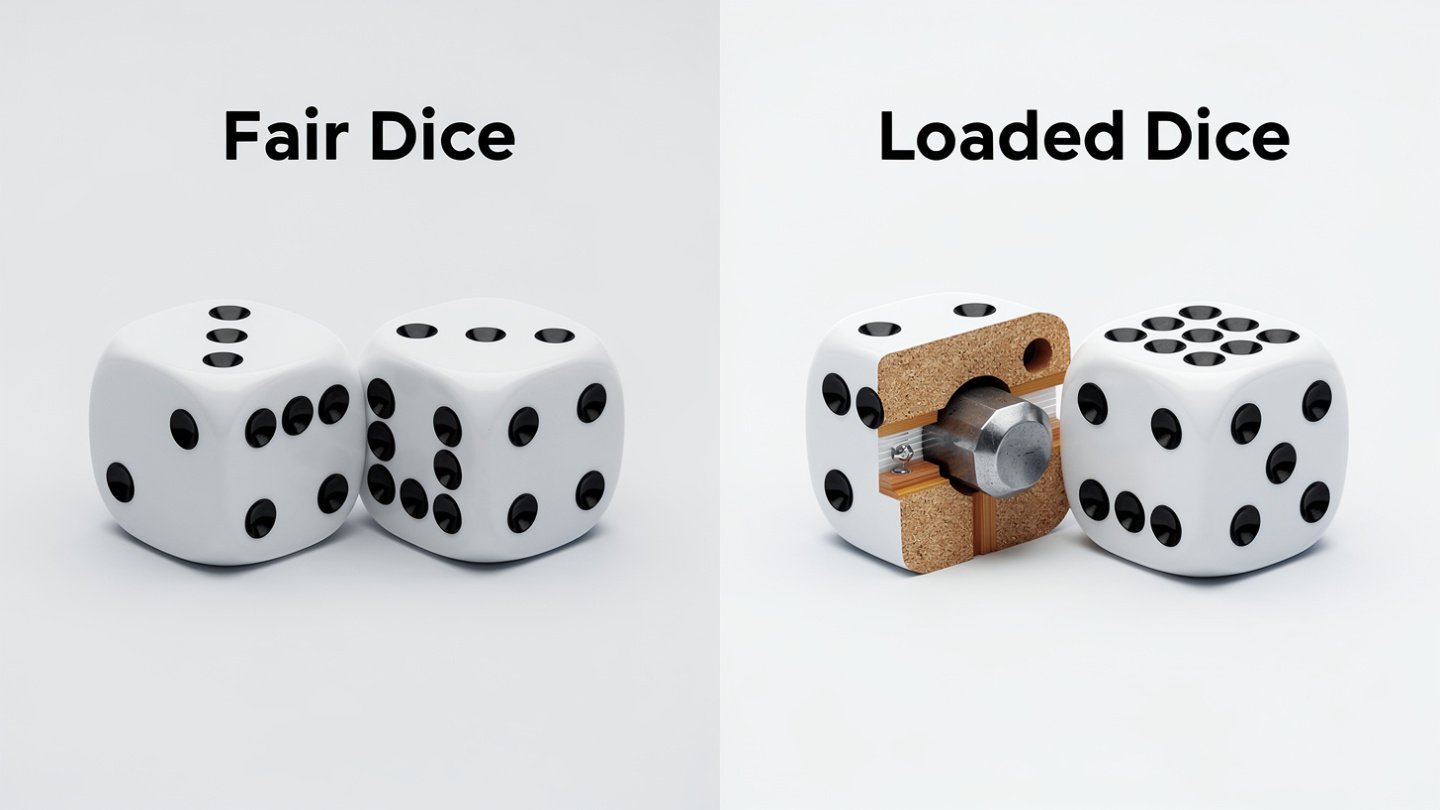
A loaded dice contains intentional or unintentional modifications that cause certain numbers to appear more or less frequently than others. The term “loaded” comes from the practice of loading one side with extra weight.
Deliberate loading methods have existed for centuries. Historical examples include drilling small holes in one face and filling them with denser material like lead. This extra weight pulls that face downward during rolls, making the opposite face appear more often. Remember, opposite faces on standard dice always add to seven, so loading the one face makes six appear more frequently.
Other manipulation techniques include shaving one or more faces to create slight rectangular shapes instead of perfect cubes. The flatter faces land upward more often because they provide more stable resting positions. The differences can be so subtle that casual observers never notice the alteration.
Temperature-sensitive materials represent another loading method. Some specially made dice use compounds that soften or harden at specific temperatures. A player can warm certain faces with body heat before rolling, temporarily changing how the dice behaves. These sophisticated versions rarely appear outside historical collections and specialized demonstrations.
Unintentional loading happens more commonly than deliberate cheating. Manufacturing defects, poor quality control, material inconsistencies, and wear over time can all create imbalanced dice. Cheap dice produced without precision equipment often show bias simply because no one verified their fairness during production.
Air bubbles trapped inside plastic dice during manufacturing create uneven weight distribution. Inconsistent pip depths across different faces have the same effect. Even something as simple as accumulated dirt in the pip holes can theoretically affect balance, though this effect is usually negligible.
The History of Loaded Dice and Fair Play
The tension between fair and loaded dice stretches back thousands of years. Archaeological discoveries reveal that ancient civilizations dealt with dice manipulation just as modern players do.
Roman writers documented concerns about dishonest dice in their accounts of social games. Loaded dice from ancient Rome have been found in archaeological sites, proving that the practice existed over two thousand years ago. The British Museum collection includes several examples of ancient loaded dice crafted with remarkable sophistication for their era.
Medieval Europe saw periodic attempts to regulate dice fairness through laws and guild standards. Dice makers in certain cities faced strict oversight to prevent fraud. Authorities recognized that public trust in games required confidence in the tools used to play them.
The scientific study of dice fairness emerged during the Renaissance when mathematicians like Gerolamo Cardano began analyzing probability. Cardano’s work in the sixteenth century included discussions about how dice imperfections affect outcomes. His writings represent some of the earliest systematic thinking about randomness and fairness in chance-based activities.
By the nineteenth century, the industrial revolution enabled mass production of dice with better consistency than handcrafted versions. Manufacturers developed standards and quality control processes to ensure fairness. This period marked a shift toward expecting dice to be reliable and honest by default rather than treating fairness as a luxury.
Today, dice manufacturing uses precision molding, computer-controlled machining, and rigorous testing protocols. Professional gaming equipment, educational supplies, and quality hobby dice undergo verification to meet fairness standards. This evolution reflects growing appreciation for how much proper tools matter to enjoyable gameplay.
How to Test Dice Fairness at Home
You do not need laboratory equipment to check whether your dice roll fairly. Several simple tests reveal significant bias using materials found in most homes.
The Float Test for Weight Distribution
This popular method uses salt water to check weight balance. Fill a clear glass with warm water and add salt gradually while stirring until the dice just barely floats. The high salt concentration creates dense water that supports the dice.
Give the floating dice a gentle spin. A fair dice should rotate freely and settle into random positions without favoring particular faces. An unbalanced dice will consistently orient the same way, with the heavy side sinking and the light side rising.
Repeat the spin several times. Fair dice show no pattern in which faces point upward. Loaded dice reveal their bias by repeatedly positioning the same faces in the same orientations.
This test works because the buoyancy of salt water essentially removes the table from the equation. You observe the dice’s weight distribution directly without interference from friction or bouncing.
The Roll Test for Statistical Outcomes
The most straightforward fairness check involves rolling the dice many times and recording results. Fair dice should produce roughly equal frequencies for all numbers over a large sample.
Roll the dice at least sixty times, preferably one hundred or more. Record each result carefully. After completing your rolls, count how many times each number appeared.
With perfect fairness and sixty rolls, you would expect each number to appear ten times. Real-world results will vary due to natural randomness, but extreme deviations suggest bias. If one number appears fifteen times while another appears only five times, investigation is warranted.
Statistical tools can quantify whether differences result from normal variation or actual bias. The chi-square test, commonly taught in high school statistics classes, provides a mathematical way to evaluate dice fairness. Many online calculators make this analysis accessible without advanced math knowledge.
Educational institutions including MIT OpenCourseWare offer free resources explaining how to perform and interpret chi-square tests for dice fairness. These resources turn a simple game tool into an opportunity for genuine statistical learning.
The Balance Test on Edge
This simple visual test checks basic symmetry. Try balancing the dice on one edge on a completely flat surface. A perfectly balanced dice should rest stably regardless of which edge you choose.
Test multiple edges. If the dice tips toward particular faces consistently, internal weight distribution may be uneven. Fair dice balance equally on all edges because the weight centers precisely in the geometric middle.
This test is less precise than float or roll tests but provides quick preliminary screening. It works best for detecting gross manufacturing defects rather than subtle biases.
Why Dice Fairness Matters for Games and Education
Fair dice create the foundation for honest gameplay. When everyone trusts that outcomes depend purely on chance rather than manipulation, games remain enjoyable and friendly. Children especially need this fairness to learn that rules apply equally to all participants.
Educational activities depend completely on fair dice. Teaching probability loses all meaning if the dice produce biased results. Students develop incorrect understanding of statistical concepts when their experimental tools contain hidden flaws.
According to the National Council of Teachers of Mathematics, hands-on probability activities using dice help students grasp abstract concepts through concrete experience. This benefit disappears if the dice do not perform as expected. Fair dice turn math lessons into reliable learning experiences rather than confusing exercises.
Family game nights thrive on trust and fun. Using quality fair dice prevents disputes and maintains positive atmosphere. Nobody enjoys games where hidden factors determine outcomes instead of honest chance combined with strategy.
Even casual entertainment games benefit from fairness. The excitement of rolling dice comes from genuine uncertainty about results. Loaded dice remove that unpredictability and make the activity boring rather than engaging.
Choosing Quality Fair Dice for Your Collection
Shopping for dice requires knowing what quality looks like. Several indicators help you identify well-made fair dice before purchase.
Look for dice from established manufacturers with reputations for quality control. Companies that specialize in gaming equipment typically maintain higher standards than generic toy producers. Read reviews from other buyers to learn about real-world experiences.
Examine the physical characteristics carefully. Faces should be perfectly flat and square. Edges should be crisp and uniform. The dice should feel substantial but not unusually heavy in any particular orientation.
Check the pips for consistency. Each dot should be drilled to the same depth across all faces. Paint fill should be even and complete. Numbers should be clearly legible without requiring close inspection.
Precision dice, sometimes called casino-grade or professional dice, undergo strict manufacturing standards and inspection. While originally developed for professional settings, these dice work beautifully for home gaming and education. They cost more than basic dice but deliver verifiable fairness.
Transparent dice offer an advantage for visual inspection. You can see directly through them to check for air bubbles, material inconsistencies, or hidden weights. While transparency alone does not guarantee fairness, it provides reassurance.
Avoid dice with unusual features like rounded edges or decorative inclusions unless you specifically want novelty items rather than fair gaming tools. These modifications may look attractive but often compromise balanced rolling behavior.
Common Myths About Dice Fairness
Several misconceptions about dice fairness persist despite lacking evidence. Clearing these up helps players make better decisions.
Myth: New dice are always fair. Reality: Manufacturing quality varies enormously. Inexpensive dice often show measurable bias right from the package. Always test new dice if fairness matters for your purposes.
Myth: Expensive dice guarantee fairness. Reality: Price correlates with fairness but does not guarantee it. Some costly dice feature artistic designs that compromise balance. Others justify high prices through materials like gemstones rather than precision. Evaluate each dice individually.
Myth: You can feel whether a dice is loaded. Reality: Subtle weight imbalances that significantly affect outcomes over many rolls cannot be detected by hand. Testing methods like float tests or statistical roll analysis provide much more reliable information.
Myth: Worn dice become loaded over time. Reality: Normal wear from regular use rarely creates significant bias. Dice would need extremely uneven wear concentrated on specific faces to develop measurable loading. Proper care maintains fairness for years.
Myth: The color of dice affects fairness. Reality: Color comes from dyes mixed into the material or applied to surfaces. Quality manufacturers ensure these additives do not affect weight distribution. Color is purely aesthetic for well-made dice.
Professional Standards for Dice Manufacturing
Understanding professional manufacturing standards helps appreciate what separates fair dice from questionable ones. High-quality producers follow strict protocols at every production stage.
Material selection starts the process. Manufacturers choose uniform plastics or resins that maintain consistent density throughout. They avoid materials prone to air bubbles, uneven curing, or internal stresses that create irregularities.
Precision molding uses computer-controlled equipment that produces identical dimensions across thousands of dice. Tolerances often measure in hundredths of millimeters. This precision ensures every face is truly square and every edge truly straight.
Pip creation requires matching the weight of material removed with the weight of paint added. Some manufacturers use alternative methods like printing or engraving to avoid the weight issue entirely. Others carefully calibrate paint density to achieve perfect balance.
Edge finishing includes tumbling to smooth sharp corners. This process must happen evenly so all edges receive identical treatment. Uneven tumbling creates dice that roll differently depending on which edges contact the table.
Quality control involves statistical testing of sample dice from each production batch. Manufacturers roll dice thousands of times and verify that results match expected probability distributions. Batches that fail testing do not reach consumers.
Companies like Chessex, Koplow Games, and GameScience built reputations specifically on manufacturing quality dice with verifiable fairness. Their products appear in educational catalogs, hobby stores, and quality toy retailers because schools and serious players trust their standards.
Appreciating the Craft of Fair Dice
Fair dice represent a remarkable intersection of geometry, materials science, manufacturing precision, and practical functionality. Creating small objects that deliver true randomness requires attention to details invisible to casual observers.
Next time you roll dice during a family game or classroom activity, take a moment to appreciate the careful work that made those honest outcomes possible. The simple cube in your hand connects ancient mathematical principles with modern manufacturing capability.
That connection between past and present, between craft and play, between precision and fun, makes dice endlessly fascinating. Fair dice let us experience genuine chance, learn authentic probability, and enjoy honest competition together.
If you found this exploration of fair versus loaded dice interesting and useful, please share it with teachers, parents, game enthusiasts, and curious learners in your community. Have you ever tested your dice for fairness? Do you have tips for identifying quality dice? Share your experiences and thoughts in the comments below. We enjoy learning from readers and continuing the conversation about these small but remarkable tools.
Note: This article is for informational and entertainment purposes only. It does not promote or encourage real-money gambling.


