


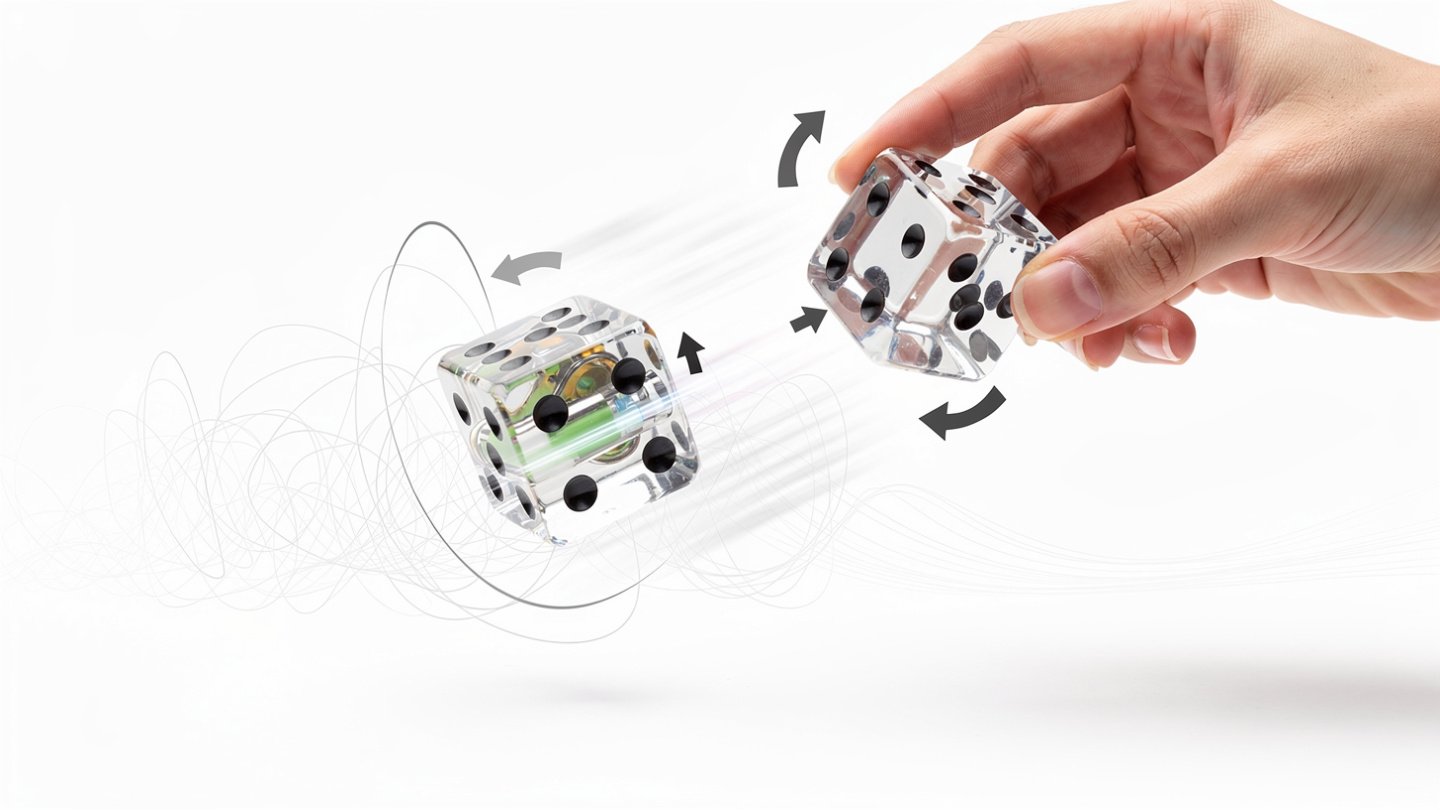
Dice are random because every roll is affected by many tiny physical factors. The angle of your hand, the force of the throw, the spin of the die, the bounce on the table, the surface texture, and the final landing position all work together to create an outcome that is hard to predict.
A die may look simple, but rolling it is a small science experiment. When it tumbles, bounces, spins, and stops, each movement changes what number may land on top. That is why the result feels unpredictable, even when the die follows normal laws of physics.
This guide explains why dice are random in simple language. You will learn how shape, balance, motion, surface, bouncing, and probability all affect dice rolls. You will also find easy experiments you can try at home or in class to see randomness in action.
What Does Random Mean?
Random means the result cannot be known in advance with certainty. When you roll a fair die, you know the possible results are 1, 2, 3, 4, 5, and 6. But before the die stops, you do not know which number will land face-up.
Random does not mean there is no pattern at all. Over many rolls, a fair die should show each number roughly the same number of times. But on one single roll, the result is unpredictable.
| Idea | Simple Meaning |
|---|---|
| Random result | You cannot know the exact result before it happens |
| Fair die | Each face has the same chance |
| Probability | The chance of a result happening |
| Unpredictable roll | Too many small factors affect the final result |
| Long-term pattern | Results become more balanced after many rolls |
For example, the chance of rolling a 6 on one fair die is 1 out of 6, or about 16.67%. But that does not mean every sixth roll must be a 6. Randomness can create streaks, gaps, and surprises.
Why Dice Rolls Are Hard to Predict
A dice roll is hard to predict because many things happen very quickly.
When you roll a die, these factors can change the result:
| Factor | How It Affects the Roll |
|---|---|
| Starting position | Which face is up before the roll begins |
| Throwing force | How hard or soft the die is rolled |
| Spin | How fast the die rotates |
| Bounce | How the die hits the table |
| Surface | Smooth, rough, soft, or hard surfaces change movement |
| Friction | Slows the die and affects final stopping position |
| Edge contact | Corners and edges decide how the die tumbles |
| Final tilt | A tiny angle can change which face lands up |
Even a very small change can produce a different final number. That is why two rolls that look almost the same can end with different results.
The Shape of Dice Helps Randomness
A standard die is a cube. It has 6 equal square faces. If the die is fair and balanced, each face should have the same chance of landing on top.
| Dice Feature | Why It Matters |
|---|---|
| Six equal faces | Gives each number a chance |
| Balanced weight | Prevents one side from landing more often |
| Even edges | Helps the die tumble fairly |
| Clear numbers or pips | Makes results easy to read |
| Solid shape | Keeps rolling behavior consistent |
If one side is heavier than another, the die may not be fair. A fair die should not prefer one number too often.
The Role of Bouncing and Tumbling
A die becomes more random when it tumbles and bounces before stopping. If you simply place a die on the table, there is no random roll. If you drop it without spin, the result may also be less random.
A proper roll usually includes:
- Shaking or moving the die.
- Releasing it with some force.
- Letting it spin or tumble.
- Allowing it to bounce on the surface.
- Waiting until it fully stops.
Each bounce changes the die’s direction. Each spin changes which face may land on top. The more natural tumbling happens, the harder it becomes to predict the final result.
How Surface Affects Dice Randomness
The surface you roll on can change how the die moves.
| Surface Type | Effect on Dice Roll |
|---|---|
| Smooth table | Die may slide more |
| Rough table | More friction, less sliding |
| Soft mat | Softer bounce and quieter roll |
| Felt tray | Controlled bounce and less noise |
| Carpet | Less bounce, slower roll |
| Glass surface | More sliding and sharper bounce |
For casual games, a table, tray, or dice mat usually works well. A tray is helpful because it keeps dice from rolling away and gives the die space to bounce.
Force and Spin Matter Too
The way a person rolls the die also affects the result. A soft roll may not tumble enough. A strong roll may bounce more and spin longer.
| Rolling Style | Possible Effect |
|---|---|
| Very soft roll | Less tumbling, less random-looking |
| Normal roll | Good bounce and natural movement |
| Very hard roll | Dice may fly off the table |
| Straight drop | Less spin and less mixing |
| Shaken roll | Better starting randomness |
For fair play, roll the die gently but with enough movement that it tumbles before stopping.
A simple rule is:
Shake, roll, bounce, and let it stop naturally.
Why Fair Dice Give Equal Chances
A fair six-sided die gives each number the same chance.
| Number | Probability |
|---|---|
| 1 | 1/6 |
| 2 | 1/6 |
| 3 | 1/6 |
| 4 | 1/6 |
| 5 | 1/6 |
| 6 | 1/6 |
This means each number has about a 16.67% chance on a single roll.
However, random results do not always look perfectly even in short tests. If you roll a die 12 times, you may not get each number exactly 2 times. That is normal.
Over many rolls, the results usually become more balanced.
Short-Term Randomness vs Long-Term Patterns
Dice can look strange in short sessions. You might roll 6 three times in a row. You might not roll 1 for many turns. These things can happen naturally.
| Number of Rolls | What May Happen |
|---|---|
| 6 rolls | Results may look uneven |
| 20 rolls | Some numbers may appear more than others |
| 60 rolls | Results may start looking more balanced |
| 600 rolls | Results usually get closer to equal chances |
Random does not mean perfectly balanced every few rolls. Random means each roll has a fair chance, even if short-term results look surprising.
Why Dice Do Not Remember Previous Rolls
Each dice roll is independent. This means the die does not remember what happened before.
If you roll a 6 three times in a row, the chance of rolling 6 again is still 1/6.
| Previous Result | Chance of 6 on Next Roll |
|---|---|
| No previous roll | 1/6 |
| Last roll was 6 | 1/6 |
| Last three rolls were 6 | 1/6 |
| No 6 in ten rolls | 1/6 |
This is important because many people think a number is “due” after it has not appeared for a while. That is not true with fair dice. Every roll starts fresh.
Why Streaks Happen in Random Dice Rolls
Streaks are part of randomness. A streak means the same number or type of result appears several times close together.
For example:
| Event | Probability |
|---|---|
| Rolling one 6 | 1/6 |
| Rolling two 6s in a row | 1/36 |
| Rolling three 6s in a row | 1/216 |
Three 6s in a row is rare, but it can happen. Rare does not mean impossible.
This is why dice games can feel exciting. A roll may surprise you, even when the die is fair.
Fair Dice vs Biased Dice
A fair die gives every face the same chance. A biased die does not. Bias can happen if the die is damaged, poorly made, unevenly weighted, or shaped incorrectly.
| Dice Type | Meaning |
|---|---|
| Fair die | Each number has equal chance |
| Biased die | Some numbers appear more often |
| Loaded die | Intentionally weighted unfairly |
| Damaged die | Chips or cracks may affect rolling |
| Poor-quality die | Shape or weight may not be even |
For normal home, classroom, or family games, standard dice are usually fair enough. But if a die is chipped, cracked, or rolls strangely often, replace it.
How Manufacturing Affects Randomness
A die should be made evenly. If one side is heavier, flatter, or shaped differently, the roll may become biased.
Manufacturing factors include:
| Factor | Why It Matters |
|---|---|
| Weight balance | Uneven weight can favor some sides |
| Face shape | Uneven faces may change landing behavior |
| Rounded corners | Can affect tumbling |
| Pip depth | Deep dots may remove tiny amounts of material |
| Paint fill | Adds small weight back into pips |
| Material quality | Air bubbles or defects can affect balance |
High-quality dice are made carefully so they roll fairly. Cheap or damaged dice may still be fine for casual play, but they are less reliable for serious testing.
Simple Home Experiment: Test Dice Randomness
You can test a die at home with a simple roll experiment.
Goal: See whether each number appears roughly equally.
Dice needed: 1 die
Rolls: 60
Time: 10 minutes
How to do it:
- Roll one die 60 times.
- Write down each result.
- Count how many times each number appears.
- Compare results with the expected number.
- Since there are 6 faces, each number is expected about 10 times.
Filled example:
| Number | Expected in 60 Rolls | Actual Example |
|---|---|---|
| 1 | 10 | 8 |
| 2 | 10 | 12 |
| 3 | 10 | 9 |
| 4 | 10 | 11 |
| 5 | 10 | 10 |
| 6 | 10 | 10 |
Small differences are normal. If one number appears extremely often and another barely appears, test again with more rolls.
Simple Experiment: Surface Test
This experiment shows how surface changes dice movement.
Goal: Compare dice rolling on different surfaces.
Dice needed: 1 die
Rolls: 30 per surface
Surfaces: Table, tray, mat, carpet
| Surface | What to Observe |
|---|---|
| Table | Does the die slide or bounce? |
| Dice tray | Does the roll stay controlled? |
| Soft mat | Does the die stop faster? |
| Carpet | Does the die tumble less? |
How to do it:
- Roll the same die 30 times on a table.
- Record the results.
- Roll it 30 times on a soft mat.
- Record the results.
- Compare how the die moved and stopped.
Observation idea:
The numbers may still vary randomly, but the movement style will feel different on each surface.
Simple Experiment: Roll vs Drop
This experiment shows why tumbling matters.
Goal: Compare a proper roll with a simple drop.
Dice needed: 1 die
Rolls: 30 rolls and 30 drops
| Method | What Happens |
|---|---|
| Proper roll | Die tumbles, bounces, and spins |
| Straight drop | Less tumbling and less mixing |
How to do it:
- Roll the die normally 30 times.
- Record the results.
- Drop the die gently from the same position 30 times.
- Record the results.
- Compare which method looks more mixed.
Learning point:
A proper roll is better for random-looking results because the die changes position many times before stopping.
Why Dice Randomness Matters in Games
Randomness makes dice games fair and exciting. If players could predict or control every roll, the game would lose surprise.
| Why Randomness Matters | Benefit |
|---|---|
| Fair play | Every player gets the same chance |
| Excitement | Results are surprising |
| Replay value | Each game feels different |
| Learning | Helps teach probability |
| Decision-making | Players must respond to uncertain outcomes |
| Family fun | Younger and older players can compete together |
Dice randomness allows a child, parent, beginner, or experienced player to all enjoy the same game.
Why Dice Are Useful for Learning
Dice are useful in education because randomness creates natural practice.
Students can use dice to learn:
- Counting
- Addition
- Subtraction
- Multiplication
- Probability
- Prediction
- Data recording
- Graphing
- Fairness
- Decision-making
For example, students can roll one die 60 times and record results. Then they can compare actual results with expected probability. This turns abstract probability into a hands-on activity.
Can Someone Control a Dice Roll?
In normal play, it is very difficult to control a fair dice roll. Too many small factors affect the final result.
A person would need to control:
| Factor | Why It Is Difficult |
|---|---|
| Starting angle | Hard to keep exactly the same |
| Release force | Small differences change movement |
| Spin | Difficult to control perfectly |
| Bounce point | Changes with every roll |
| Surface friction | Not perfectly uniform |
| Final landing | A tiny tilt can change the result |
This is why proper rolling rules matter. Dice should be rolled with enough movement, not placed or gently slid.
Good Rolling Habits for Fair Play
Use these habits for fair and random-looking rolls:
- Shake the die before rolling.
- Roll on a flat surface.
- Use a dice tray or bowl.
- Let the die bounce or tumble.
- Do not slide the die.
- Do not drop it from a fixed position.
- Let the die stop naturally.
- Reroll if the die lands tilted or off the table.
A simple fair-play rule is:
A roll should tumble before it counts.
Common Misconceptions About Dice Randomness
| Misconception | Correct Explanation |
|---|---|
| A number is due after many misses | Each roll is independent |
| Rolling harder guarantees randomness | A normal tumbling roll is enough |
| A streak means the die is unfair | Streaks can happen naturally |
| Every 6 rolls must show each number once | Short-term results vary |
| Smooth surfaces are always better | Surface affects bounce and sliding |
| Random means no pattern ever | Long-term patterns can still appear |
Understanding these points helps players trust fair dice and avoid common mistakes.
Physical Dice vs Digital Dice Randomness
Physical dice and digital dice both can produce random-looking results, but they work differently.
| Type | How It Works |
|---|---|
| Physical dice | Randomness comes from motion, bounce, spin, and surface |
| Digital dice | Randomness comes from a computer-generated number process |
Physical dice feel natural because players can see the roll happen. Digital dice are useful for apps and online tools, but players may not see the physical process.
Both can be fair if designed or made properly.
Probability Behind a Fair Die
For a fair six-sided die, each number has equal probability.
| Result | Chance |
|---|---|
| 1 | 16.67% |
| 2 | 16.67% |
| 3 | 16.67% |
| 4 | 16.67% |
| 5 | 16.67% |
| 6 | 16.67% |
For two dice, the totals are not equally likely. For example, 7 is more common than 2 or 12 because there are more ways to roll 7.
| Sum | Chance Level |
|---|---|
| 2 | Rare |
| 3 | Less common |
| 6 | Common |
| 7 | Most common |
| 8 | Common |
| 11 | Less common |
| 12 | Rare |
This is why dice are useful for teaching probability. One die shows equal chances, while two dice show how combinations change probability.
Randomness Terms Glossary
| Term | Simple Meaning |
|---|---|
| Random | Cannot be predicted exactly |
| Probability | Chance of a result |
| Fair die | Each face has equal chance |
| Biased die | Some faces appear more often |
| Independent roll | One roll does not affect the next |
| Streak | Same result happening several times |
| Friction | Surface force that slows the die |
| Spin | Rotation of the die |
| Bounce | Contact with the surface that changes direction |
| Tumble | Rolling over edges and corners |
FAQs About Why Dice Are Random
Why are dice random?
Dice are random because each roll involves many small factors, including force, spin, bounce, angle, surface, and final landing position. These factors make the result hard to predict.
Is a dice roll truly random?
A physical dice roll follows physics, but it is practically unpredictable because tiny differences in motion and surface contact can change the result. For normal games and learning, this makes dice random enough.
Does rolling harder make dice more random?
Not always. A normal roll with tumbling and bouncing is enough. Rolling too hard may cause the die to leave the table. The goal is controlled tumbling, not extreme force.
Can dice remember previous rolls?
No. Dice do not remember previous results. Each fair roll is independent, so the chance of rolling any number stays the same every time.
Why does the same number appear many times?
Streaks can happen naturally in random results. Rolling the same number several times does not automatically mean the die is unfair.
How can I tell if a die is fair?
Roll it many times and record the results. In 60 rolls, each number may appear close to 10 times, but small differences are normal. For better testing, use more rolls.
What surface is best for rolling dice?
A flat table, dice tray, felt mat, or soft rolling surface works well. The surface should let the die tumble without rolling away.
Final Thoughts
Dice are random because a roll includes motion, spin, bounce, friction, surface contact, and final resting position. These factors happen quickly and are difficult to control perfectly. A fair die gives each face an equal chance, but each single roll remains unpredictable.
Randomness is what makes dice useful for games, learning, and family fun. It creates surprise, fairness, and replay value. It also helps teach probability in a hands-on way.
To see randomness yourself, try a simple experiment. Roll one die 60 times, record the results, and compare them with the expected pattern. You may not get perfect results, but that is part of what makes dice interesting.
Note: This article is for educational and entertainment purposes only. It does not promote betting, casino play, or real-money gambling.


